

Claude Gatekeeping Controversy, Solar Surpasses Coal, SpaceX Unveils AI Satellite
Research Rundown #189, plus a new memo on Periodic Labs
Fable’s Gatekeeping Angers Users
When Anthropic launched Claude Fable 5 on June 9, its initial plan was to run automated safety checks on every request and visibly reroute queries touching cybersecurity, biology, and thinking-extraction to Claude Opus 4.8, with a notice explaining the switch — but the company also shipped a second, quieter layer: an invisible safeguard for frontier LLM development work that, per the system card, would limit the model’s effectiveness through prompt modification, steering vectors, or parameter-efficient fine-tuning without any fallback or notification, a measure partly aimed at preventing distillation of the model’s outputs.
After researchers branded the silent degradation “secret sabotage,” Anthropic repositioned, apologizing for making “the wrong tradeoff” and announcing that the invisible safeguards would become visible, with affected queries falling back to Opus 4.8 and users notified. The general user response has been harshly negative across the board: cybersecurity professionals complained the restrictions were so keyword-driven that even writing secure code or reading a blog post triggered downgrades, former employees argued the approach would slow scientific progress on problems like cancer and Alzheimer’s, and frustrated users vented that any science-related queries were flagged, with one remarking “I wouldn’t use this thing for anything to be honest. A refusal or HTTP-4xx error for content is fair enough, but this is basically taking your money and poisoning your code base.”
The story escalated further late Friday, when the US government issued an export control directive ordering Anthropic to suspend all access to Fable 5 and Mythos 5 for every customer, citing a national security concern related to a possible jailbreak. Anthropic complied but said that the jailbreak in question surfaced only minor, already known vulnerabilities that were discoverable by other publicly available models, including GPT-5.5. It also argued that recalling a model deployed to hundreds of millions of users over a narrow, non-universal jailbreak would effectively halt frontier deployments industry-wide if applied as a standard.
Solar’s Quiet Surge
US solar generation surpassed coal for the first time last month, supplying 12.8% of national electricity to coal’s 12.2%. In doing so, it became the third-largest source of electricity in the US, behind natural gas and nuclear. The milestone comes after two decades of roughly flat US electricity demand, which is now rising again due to AI, manufacturing, and electrification. Solar’s surge accounts for almost all the net new energy supply in the country; solar and battery storage made up 91% of all new US generating capacity in the first quarter of 2026.
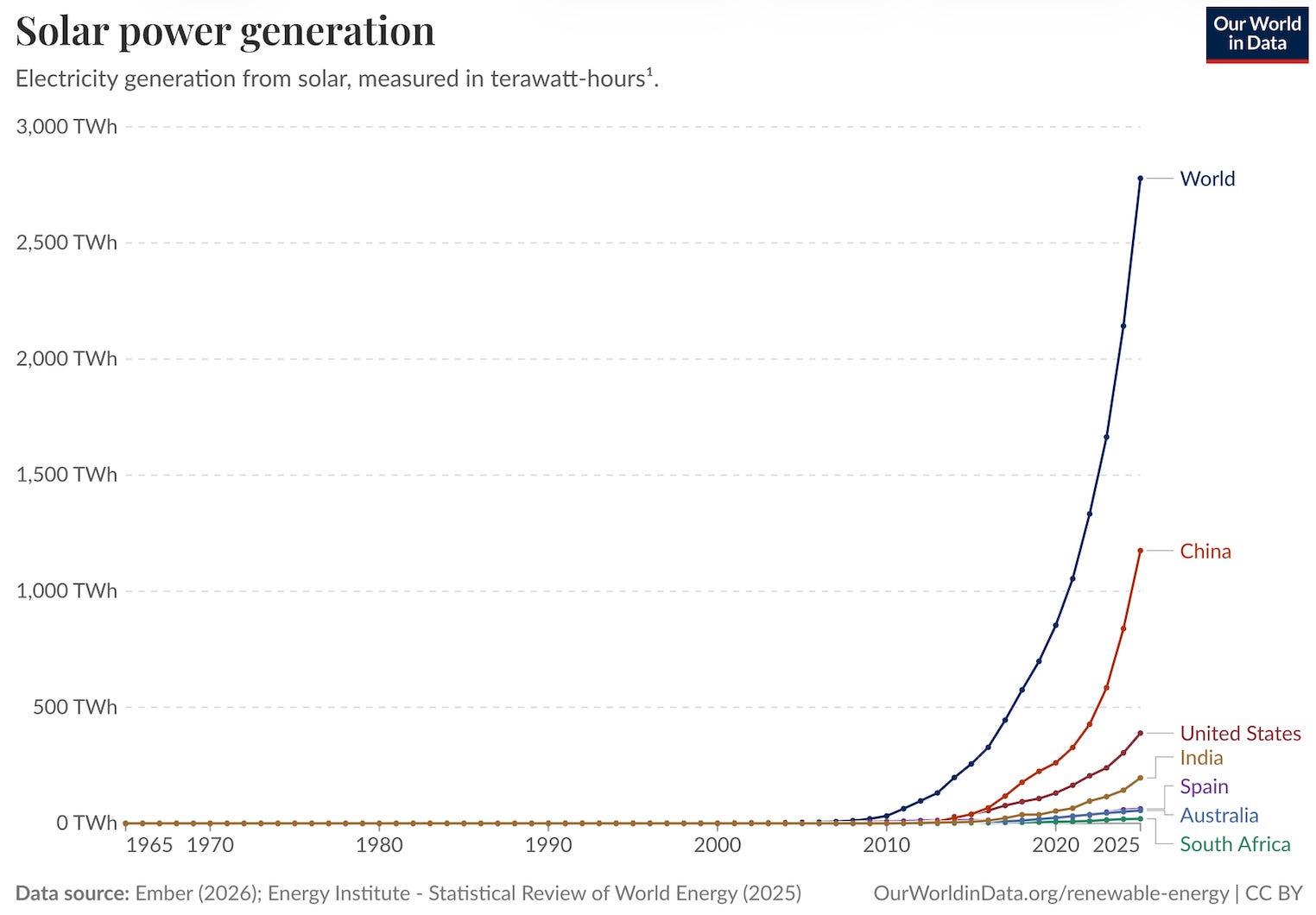
The story of solar growth in the US reflects a global pattern that has been building for decades. Solar photovoltaic costs have fallen 90% over the last decade alone, following a remarkably consistent pattern known as Wright’s Law, which states that every time global cumulative solar capacity doubles, costs fall by roughly 20%. Global solar generation has grown from a negligible amount before 2010 to nearly 2,800 TWh in 2025, roughly tenfold in 15 years, with China alone now generating over 1,100 TWh. The cumulative effect over four decades has taken solar from one of the most expensive sources of electricity to the cheapest in many markets.
SpaceX Unveils AI Satellite
Ahead of SpaceX’s IPO this week, the company unveiled a significant milestone on the way to its orbital data center ambitions: 230-foot “AI1” satellites that generate 150 kW of peak power each, connected via laser links to each other and to Starlink. SpaceX said that it is to launch a dedicated AI satellite factory by the end of next year, and argued that the underlying technology is largely an extension of what SpaceX already built for Starlink V3. The company’s experience operating over 10K satellites will give it a unique advantage in managing an AI data center constellation that could reach up to one million satellites at scale.
The AI1 announcement occurred just days before the company underwent the largest IPO in history. SpaceX closed its first day of trading up 19% at $161 per share, valuing the company at $2.1 trillion after pricing at $135 and opening at $150. More than 500 million shares traded hands, a volume approaching Facebook’s 2012 debut. Elon Musk said SpaceX has been cash-flow positive since around 2015 and is going public now to fund a “significant growth phase,” including launching over 100K satellites and building AI data centers in space. Regardless of the triumphant IPO, or perhaps because of it, skeptics remain, with one calling the company’s $28.5 trillion total addressable market a “hallucination” and even Musk himself giving SpaceX a 10% chance of success as he defines it.
Latest Research
Periodic Labs was founded last year to build autonomous laboratories and is already valued at $7 billion. Read our new report here.
What We’re Reading
Anthropic launched Claude Fable 5, its first generally available Mythos-class model at $10/$50 per million tokens (less than half Mythos Preview’s price), with classifier safeguards routing ~5% of cyber/bio/chemistry/distillation queries to Opus 4.8 instead.
Relatedly, Anthropic imposed a mandatory 30-day data-retention policy on all Mythos-class traffic, overriding Zero Data Retention agreements on the Claude API, AWS Bedrock, Google Cloud Agent Platform, and Azure Foundry, citing the need to detect Best-of-N jailbreaks, state-sponsored espionage, and data-extortion patterns that only surface across many requests.
OpenAI filed a confidential S-1 with the SEC and announced the filing preemptively (“we expect it to leak so we’re just announcing it”), targeting a potential Q4 2026 / September debut at up to a $1 trillion valuation; OpenAI plans to facilitate an employee tender offer alongside the public option.
OpenAI weighed drastic token-price cuts in anticipation of similar moves from Anthropic, as both head toward IPOs with very different unit economics; CEO Sam Altman has called AI costs “a huge issue” for business customers as AI spend grows.
China readied a ~2 trillion yuan ($295 billion) five-year plan to build a nationwide network of interconnected state-operated AI data centers, run by China Mobile and China Telecom and sourcing over 80% of chips and equipment domestically from suppliers like Huawei as opposed to Nvidia and AMD.
SpaceX unveiled AI1, its first “AI satellite,” ahead of its Friday IPO with a 70-meter wingspan, a 20-meter-tall orbital data center delivering up to 150 kW of compute through onboard chips, solar arrays, and an 110-sq-meter radiator to dump heat into space.
Asset managers filed 25 SpaceX-themed ETFs with the SEC ahead of Friday’s $1.75T Nasdaq debut (ticker SPCX), 12 of them 2x long or short and two filed for 3x leverage, with three pre-IPO SpaceX-exposure ETFs pulling $4.1 billion in May inflows plus $645 million in early June, and BlackRock launching iShares Space Technologies UCITS (STAR) for Europe.
The CFTC proposed the first federal regulatory framework for prediction markets, a “balancing test” that would permit most sports trading and event contracts but restrict bets on player injuries, officiating, and “first-pitch” gambling, and bar contracts on war, terrorism, or assassinations as not in the public interest, asserting exclusive federal jurisdiction over Kalshi, Polymarket, and ProphetX.
Over 1K current and former SpaceX employees organized a collective-bargaining group through RIA Choreo to negotiate wealth-management fees below 0.5% AUM (vs. the ~1% industry standard) ahead of Friday’s IPO, with combined assets estimated at ~$20 billion, plus access to direct indexing, equity-backed lending, and other ultra-high-net-worth services typically gated to individual investors.
Jeff Bezos backed Flourish, a neuro-AI startup led by ex-Amazon S-team executive Rob Williams and neuroscientist Thomas Reardon, with a $500 million raise at a $2.5 billion valuation to study the brain’s architecture and build “Cortex AI,” a system aiming to learn continuously and run at a fraction of today’s LLM power.
Niantic Spatial partnered with Vantor to integrate ~30 billion Pokémon Go player environmental scans into a GPS-denied military drone navigation stack combining ground-level VPS with Vantor’s aerial Raptor software, with field testing planned in early 2026.
At Contrary Research, we’ve built the best starting place to understand private tech companies. If you're interested in researching and writing about tech, apply here for our Research Fellowship!