

Is the Memory Shortage Intentional?
Our latest deep dive unpacks the market action around memory prices


The narrative in AI infrastructure over the last two years has been dominated by the enormous and growing demand for compute capacity and its economic consequences, such as the buildout of data centers and the consequent shortages of key resources such as land, water, power, and copper.
But of all these bottlenecks, memory is by far the most significant. The demand for memory is now outpacing the demand for other drivers of compute capacity. The implications of this will ripple through not just the economics of data centers, but the cost of every single consumer and enterprise hardware device.
In this piece, we unpack the market action around memory prices, its ripple effects across the consumer and industrial electronics market, and the supply and demand curve that is emerging around AI. Critically, we explain why the amount of memory being purchased by AI companies like OpenAI seems to be more than what they need, and how the threat of on-device inference might actually be incentivizing an engineered memory shortage.
Memory Prices in 2025 & 2026
The price of memory has been incredibly volatile in the last two years. Memory market disruption began in the summer of 2025 with volatile tariff policies. During this period, companies minimized the risk of unexpected pass-through costs by reducing safety stock orders, lowering demand relative to earlier in the year.
At the same time, the secondary memory market stagnated. Typically, global memory production capacity expands when major producers, such as Samsung, upgrade their lines and sell legacy equipment to budget manufacturers. This cycle effectively halted when Korean firms, fearing US retaliation for selling technology to China-adjacent entities, chose to warehouse functional machinery rather than resell it, leaving valuable production capacity idle. This slowdown was exacerbated by the US Commerce Department imposing strict licensing requirements to import US equipment on semiconductor giants like Samsung and SK Hynix.
The price increases in memory began in fall 2025 when hyperscalers and frontier AI giants began formalizing plans and budgets for data center capital expenditures in 2026 and beyond. These price increases began with ostensibly one-off 10% hikes from makers of data storage hardware, TSMC and Sandisk, in early September 2025, which were followed in the next two weeks by a 30% price increase from Micron, a primary manufacturer of DRAM and NAND memory chips.
In October 2025, it was reported that OpenAI alone planned to consume up to 40% of global DRAM availability, or 900K wafers per month, for its global Stargate compute cluster. This memory capacity would be supplied via two deals signed simultaneously with Samsung and SK Hynix. As part of this deal, Samsung would work with OpenAI on the operation and architecture of the Stargate data center in South Korea. These deals were both to buy uncut, unfinished raw wafers, not completed memory modules, leaving flexibility for the creation of RAM variants or HBM memory stacks (though Samsung and SK Hynix will likely be the companies making these components). South Korean presidential adviser, Kim Yong-beom, said in October 2025 that OpenAI was “seeking to order 900,000 semiconductor wafers in 2029,” but did not clarify how many the company would be purchasing per month in the period between 2025 and 2029. The production of 900K wafers per month would not likely be achieved until closer to 2029, as Samsung and SK Hynix were estimated to have around 680K and 620K wafers per month capacity, respectively, as of February 2026. Claims that OpenAI will be consuming 40% of global memory output are based on future capacity projections.
This announcement further increased prices for memory hardware components of all types, given the degree of interchangeability of memory infrastructure components with differing speed and permanence characteristics. In the following months, memory price growth further accelerated with contracting supply: In early December 2025, DRAM inventory levels were down 80% versus the same time in 2024, falling to only three weeks of available supply at then-current consumption rates (down from 9.5 weeks of supply in July 2025).
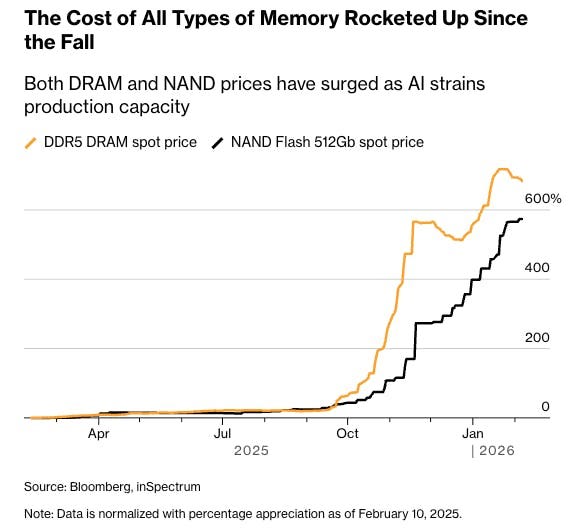
As of February 2026, prices have risen over 500% for NAND chips and over 600% for DRAM chips. The impacts of this sudden increase in prices are wide-reaching, but their drivers may be even more important. Will lower memory availability to consumers increase reliance on cloud-based storage and demand for data centers? Is the window of opportunity for on-device AI closing as soon as it has opened?
As of February 2026, prices have risen over 500% for NAND chips and over 600% for DRAM chips. The impacts of this sudden increase in prices are wide-reaching, but their drivers may be even more important. Will lower memory availability to consumers increase reliance on cloud-based storage and demand for data centers? Is the window of opportunity for on-device AI closing as soon as it has opened?
The excerpt above is the first section of our new deep dive on memory. See the full report here.