

Mapping the Shadow Grid
Our latest deep dive on the rise of behind-the-meter power for AI data centers


In September 1882, Thomas Edison opened Pearl Street Station in lower Manhattan, a coal-fired plant serving 85 customers within a one-square-mile radius. Prior to Pearl Street, every factory and building that required electricity ran its own generator. Samuel Insull, Edison’s 21-year-old secretary at the time, spent the next four decades consolidating those islands of private power into a national system. By 1932, electricity from Insull’s grid was available in 22 states across 5K cities and towns.
The economics of this early electric grid were simple: a central utility could average demand peaks across thousands of customers and produce power far more cheaply than any individual factory running its own generator. As a result, private generation gradually became uneconomic. The regulatory compact that emerged from this system has governed American electricity ever since: private utility companies get territorial monopolies in exchange for rate regulation and public oversight.
A century after Insull attempted to make private generation obsolete, the economics that supported the formation of the early grid have inverted. Grid connection timelines stretch to seven years in major markets, and permitting has become a decade-long gauntlet.
For AI data centers that stand to generate $10-12 billion per gigawatt annually, this wait has become commercially unsustainable. The response has been a return to the world before Pearl Street, in which companies are once again generating their own power, privately and outside the traditional oversight mechanisms that have governed electricity since the Depression. The 56 gigawatts of announced “behind-the-meter” (BTM) power plant capacity now under construction is the largest reversal of the centralized utility model in US history.
Behind The Meter Buildout
Referred to as the “shadow power grid”, this network of at least 47 off-grid data center power sources is billed by developers as an alternative to drawing on existing grid resources. As of February 2026, this BTM grid accounted for 30% of planned US data center capacity. Nearly 90% of that capacity was announced in 2025 alone, concurrent with overall data center construction slowing relative to 2024, as permitting and grid connectivity barriers became harder to work around. What started as an improvised, potentially temporary workaround has increasingly become a standard development model. BTM systems are expected to meet roughly 25-33% of the additional electricity demand from data centers projected through 2030.
In February 2026, the White House reported that Amazon, Meta, Oracle, xAI, Google, OpenAI, and Microsoft would pledge to supply their own power for data centers. The pledge followed President Trump’s “Ratepayer Protection Pledge,” which called on AI companies to build, bring, or buy all the energy needed for their data centers; this effectively sanctioned the BTM model at the federal level and provided political cover for the state-level regulatory changes that enable it.
Unlike the data centers developed over the last decade (concentrated in Northern Virginia, the Pacific Northwest, and the Chicago suburbs), this new shadow grid is taking root in states with greater tolerance for private power generation and fossil fuel infrastructure. BTM deployment is extremely concentrated geographically. Five states (Texas, New Mexico, Pennsylvania, Utah, and Wyoming) account for 83% of proposed BTM capacity. Of the 190+ data center bills introduced in state legislatures in the first eleven months of 2025 (nine times the total number proposed in 2024), almost all legislation that actively encourages data center development passed through Republican-controlled chambers.
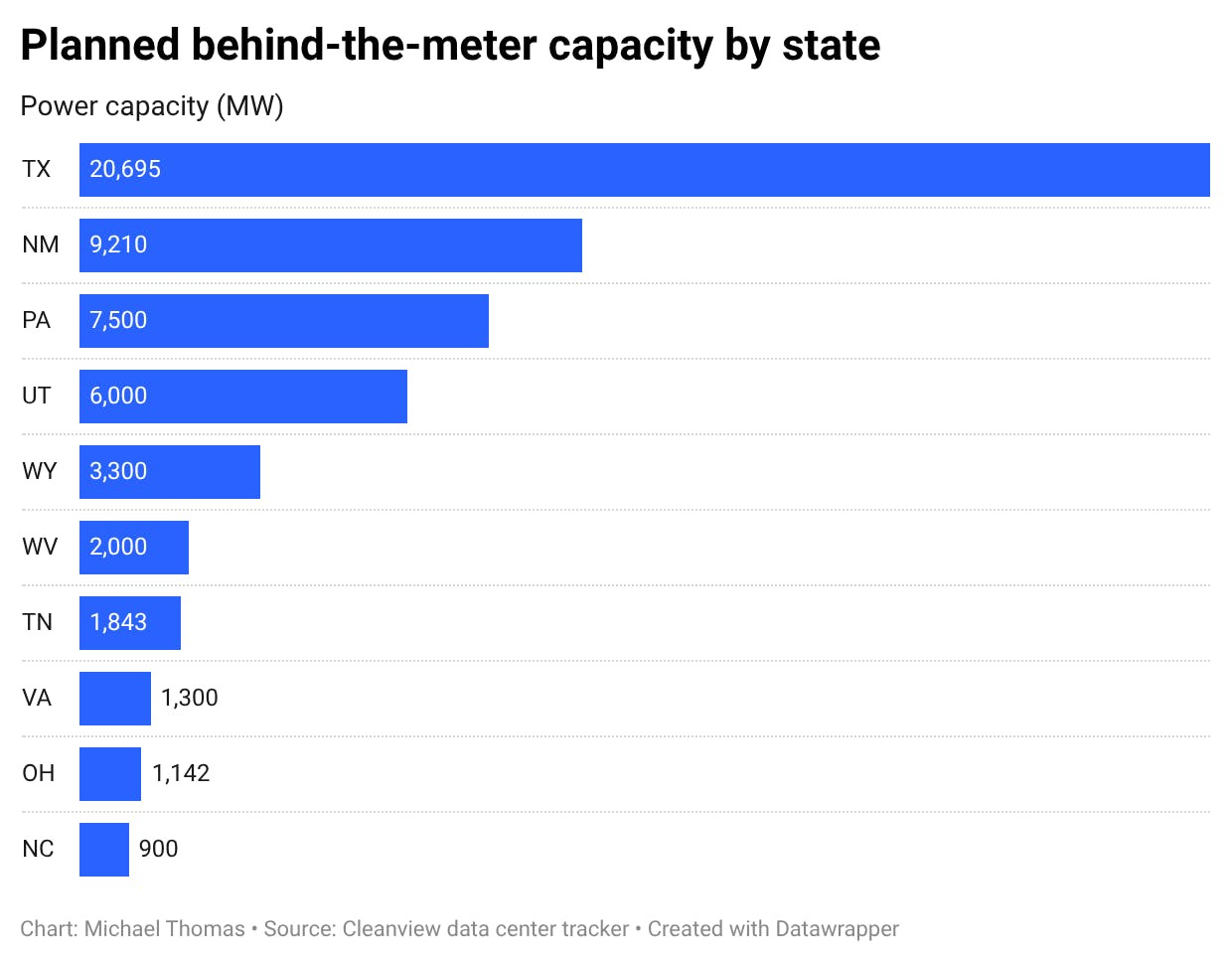
Inherent in the question of how large this shadow grid will become are the questions of why it is emerging in these particular places, with these particular characteristics. Three forces are independently pushing development toward off-grid solutions and toward a specific set of states: (1) prohibitively long timelines for connecting large loads to existing grids; (2) cost and supply constraints that make natural gas the only fuel deployable at the required speed; and (3) a widening divergence in regulatory frameworks that has made some states easier to build BTM power plants in than others.
Grid-Connection Timelines
The most immediate driver of BTM development is that connecting a large data center to the grid simply takes too long. In high-demand regions like Northern Virginia (historically the largest data center market in the United States), queue times for grid interconnection can stretch up to seven years.
There are two types of grid-connection delays. The first is the straightforward administrative process of interconnecting to a grid with spare capacity, in which a developer submits studies, installs metering, and signs a contract. This can take several months to several years, depending on the jurisdiction and the utility’s responsiveness. The second (and more pressing) bottleneck is connection to a grid that does not yet have the generating capacity to support a new load. In this case, the developer must wait not only for interconnection studies but for new transmission infrastructure and new power plants to be planned, permitted, financed, and built.
This bottleneck is geographically asymmetric in ways that explain where BTM development is concentrating. The legacy data center markets (Virginia, the Mid-Atlantic) are served by interstate grids whose interconnection queues have grown steadily for a decade; this is compounded by the retirement of baseload generation and limits on new gas pipeline capacity. For instance, projects that became operational in PJM, the interstate grid serving Virginia, Pennsylvania, and much of the Mid-Atlantic, spent an average of eight years in the interconnection queue in 2025, up from under two years in 2008. Of the 294 gigawatts that PJM studied between 2020 and 2025, 74% ultimately withdrew before reaching commercial operation.
In contrast, Texas’s ERCOT, an independent grid not subject to Federal Energy Regulatory Commission (FERC) jurisdiction, added more generating capacity in 2024 than any other grid in the country. Developers facing the worst grid-connection delays are being disproportionately pushed towards markets like Texas, and the broader interior South, where grids are expanding and permitting is faster.
This push is compounded by the fact that in most high-demand coastal and Mid-Atlantic states, BTM projects still face substantial regulatory friction, including federal environmental permitting requirements and state and local power plant regulations that can subject them to extended review processes. The result is that the same regions that are congested on the grid side are often also restrictive on the private generation side. It is this combination that explains why BTM deployment is not occurring in places like Virginia despite severe grid bottlenecks, but is instead concentrated in Texas and parts of the interior South, where developers can both secure natural gas infrastructure for their BTM power plants and move through permitting processes quickly enough to keep pace with demand growth.
Cost and Equipment
In addition to grid connection times, the equipment needed to build large-scale grid-connected generation is expensive, backordered, and increasingly scarce. This constraint has pushed developers to improvise, sourcing whatever generation equipment can be delivered within months rather than years, and has shaped the fuel mix, technology choices, and geographic footprint of the shadow grid.
Natural Gas: The Dominant Near-Term Fuel
Approximately 75% of the BTM generation capacity that has been publicly identified, roughly 23 gigawatts out of 31 gigawatts, is natural gas-fired. The dominance of natural gas is likely due to its continuity, well-developed infrastructure in key markets, and the ability to source, ship, and commission alternative gas generators on timelines that match data center development schedules.
The above is an excerpt from our new deep dive on behind-the-meter power for data centers. See the full report here.
75% natural gas. 83% in five states. The shadow grid is a geographic restructuring of AI compute. Latency assumptions change when compute capacity sits in the interior South rather than near the coastal demand it serves.