

Q-Day: Mark Your Calendars
In quantum computing, “Q-day” refers to the moment in time when quantum computers advance far enough to break any existing encryption systems on Earth. In a blog post from its cryptography team this week, Google moved up its estimate for “Q-Day” to as early as 2029, when previous estimates had placed this point in the 2030s (or later). This revision is driven in part by progress in quantum hardware and error correction, but most notably by a dramatic reduction in the number of qubits needed to crack 2048-bit RSA encryption (from 20 million to one million) reported by the Google Quantum AI team in June 2025.
In response, Google is accelerating its own migration to post-quantum cryptography (PQC) and plans to continue rolling out PQC protections across products like Android, Chrome, and its cloud services; Companies like Apple, Signal, and Cloudflare are doing the same. The NSA has a deadline of 2031 set for PQC readiness across national security systems. The question for users of these services and those without PQC adaptations alike is whether it’s already too late: cryptographers warn of “harvest now, decrypt later” (HNDL) attacks in which actors download non-PQC-encrypted data today and wait until more advanced technologies become available to decrypt it.
Slowing Data Center Construction
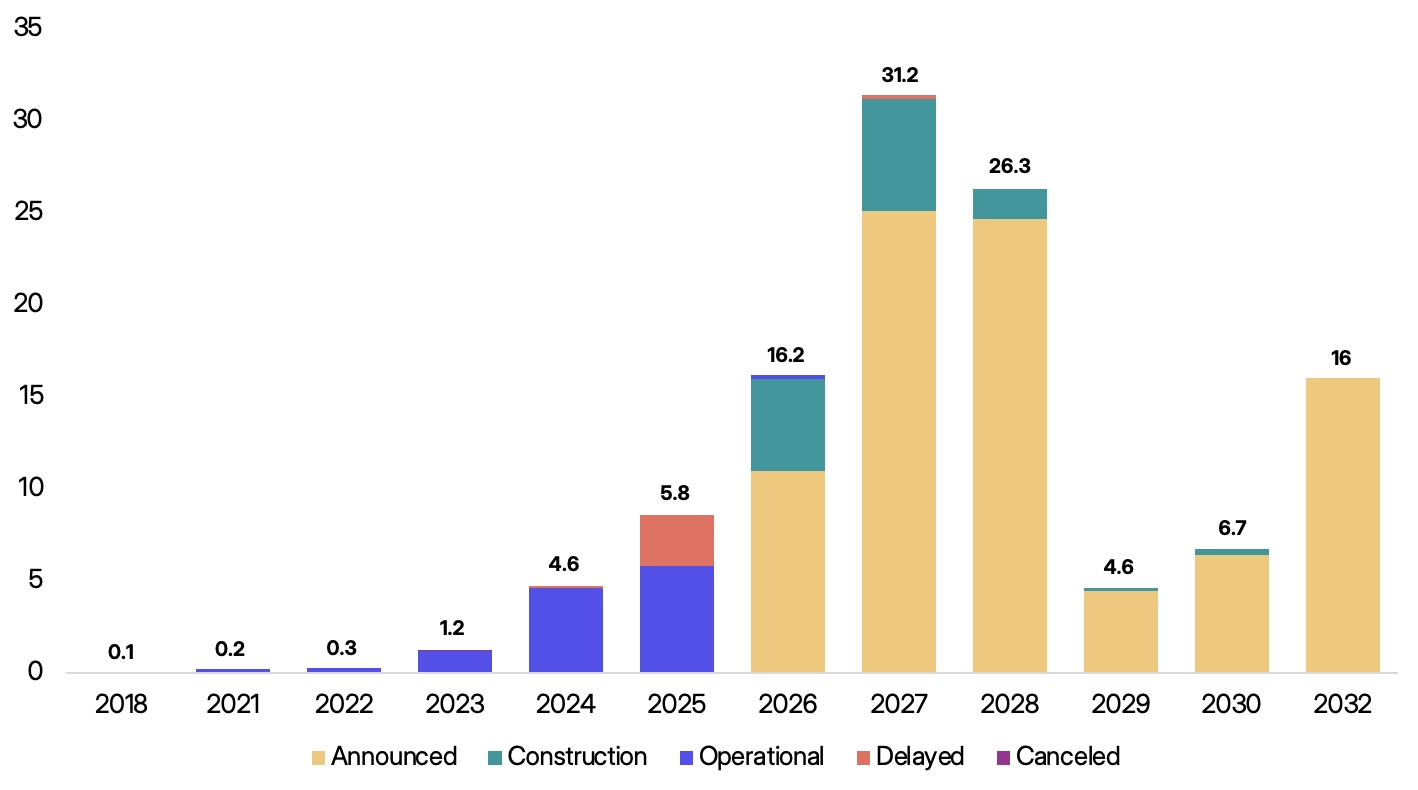
Last month, UK-based Sightline Climate published a Data Center Outlook report on 777 “large data centers and AI factories” (>50MW) announced since 2024. The report found that “At least 16GW of capacity is slated to come online in 2026 across roughly 140 projects. Yet only about 5GW is currently under construction. Around 11GW remains in the announced stage with no visible construction progress, despite typical build timelines of 12–18 months.”
This echoes the 2025 decline in data center starts documented by CBRE, and the falling ratio of active data center development to planned capacity reported by WoodMac. Data center projects are further hamstrung by the fact that over half of utility grid-approved projects have been okayed for “wires-only” connectivity, meaning operators will have to supply their own power, an equally daunting prospect given supply shortages for gas turbines and regulatory hurdles for alternatives like SMRs.
SpaceX Targets $75 Billion IPO in June
This week, it was reported that SpaceX is weighing a fundraising target of up to $75 billion in its IPO at a valuation of $1.75 trillion. This would make SpaceX’s IPO the largest in history, more than twice as large as the previous record-holder, Saudi Aramco, which raised $29 billion in 2019. It was also reported that the company will file for the IPO as soon as next week and plans to go public in June. Things have been moving quickly for SpaceX, which acquired xAI just last month in a deal valuing xAI at $250 billion and SpaceX at $1 trillion before initiating a rebuild of the AI company “from the foundations up”.
Aside from xAI, as we covered in our updated report last week, SpaceX has always had two distinct parts: the launch business and Starlink. On the launch side, SpaceX controls over 95% of the domestic launch market and holds more than $22 billion in active government contracts. Starlink, on the other hand, has over 10 million subscribers across 160 countries and is experiencing rapid growth, producing ~$15 billion in revenue, between 50%-80% of SpaceX’s total last year, and $8 billion in profit. Despite this, the fact that xAI is burning over $1 billion in cash every quarter may be one reason why the company is targeting such an aggressive IPO timeline and fundraising target.
What We’re Reading
Google is reportedly funding a multi-billion-dollar 7.7 GW Texas data center, which will rely on direct gas supplies to avoid delays connecting to the electrical grid and will be leased to Anthropic.
Elon Musk announced “Terafab,” a 100 million-square-foot semiconductor manufacturing facility in Austin, Texas, designed to produce cutting-edge AI and robotics chips to alleviate production shortages for Tesla and SpaceX.
Google Research introduced TurboQuant, a vector quantization algorithm that achieves up to an 8x compute speedup on H100 GPUs with negligible accuracy loss, using PolarQuant and Quantized Johnson-Lindenstrauss methods to compress large language model key-value caches to 3 or 4 bits.
The Artificial Intelligence Data Center Moratorium Act proposes a nationwide halt on the construction of AI data centers requiring peak power loads over 20 megawatts and prohibits the export of US-origin GPUs until federal AI and environmental safeguards are enacted.
Apple’s iOS 27 update will transition Siri into a system-wide AI agent codenamed “Campo,” featuring text-and-voice conversational capabilities, a standalone app for threaded chat histories, and a dedicated “Ask Siri” button for processing personal device data.
Apple is deploying a closed-auction advertising platform within its Maps app for users in the US and Canada later this year, allowing businesses to use the Apple Business portal to bid on search queries and “Suggested Places” slots powered by first-party targeting.
Shifting away from its traditional intellectual property licensing model, Arm Holdings introduced its first proprietary hardware, the “Arm AGI CPU,” which will be integrated into Meta data centers as soon as this year.
Uber is launching Europe’s first commercial robotaxi service in Zagreb, Croatia, by integrating Pony.ai‘s autonomous driving systems into Arcfox Alpha T5 electric SUVs, which will be managed and operated by Rimac spin-off Verne.
Legal tech startup Harvey, which uses generative AI to automate complex document analysis for law firms, secured a $200 million funding round co-led by Sequoia Capital and GIC, valuing the company at $11 billion.
OpenAI is finalizing a $10 billion capital injection from investors including MGX, Coatue Management, and Thrive Capital, bringing the total of its latest funding round to $120 billion and establishing a post-money valuation of $850 billion.
At Contrary Research, we’ve built the best starting place to understand private tech companies. If you're interested in researching and writing about tech, apply here for our Research Fellowship!
https://marcsean.substack.com/p/a-handful-of-bullets-a-western-7?utm_source=share&utm_medium=android&r=6kir8t