

The American Missile Crisis
Our latest deep dive on rethinking the missile supply chain.


Recent global conflicts, from Russia and Ukraine to Iran and Israel, have seen a resurgent awareness of the frailty of US munitions stock, which has been drawn down by both direct and indirect involvement in these events. While exact stockpile volumes are not disclosed, it is estimated that supplies of US warheads and the missiles that carry them have declined by nearly an order of magnitude since their peak during the Cuban Missile Crisis. Analysts have estimated that in the event of a conflict in the Pacific between China and Taiwan, US munitions supplies could be depleted in as few as three days, with some higher-tier terminal-phase missile supplies potentially depleted in the first 24 hours of conflict.
This was a foreseeable problem. Advocates for deterrence have supported expanding munitions stockpiles and accelerating production timelines for decades. While improving technical performance (precision and range) is useful, increasing attritable mass, or the volume of munitions that can be produced and pointed at a target set per year, is the actual measure of credible deterrence. And we have a critical bottleneck problem.
Historically, the decline of US munitions production capacity has been attributed to the bottleneck imposed by solid-rocket motor (SRM) casting, which only a handful of US companies are authorized to perform as of May 2026. The limitation on expanding solid rocket motor production is not inherent to the motor mechanics, but rather the fuel these motors use for power: ammonium perchlorate (AP). AP is the oxidizer that enables high-performance SRM in the inventory, bound with powdered aluminum (fuel) in rubber to form a controlled explosive. This fuel is cured inside motor castings for multiple days in heavily regulated environments designed to prevent cracks or voids in the cured grain that can cause the motor to over-pressurize and explode.
The handling required for AP not only limits SRM production but also the production of AP itself. In the period following the Cold War, there were two primary AP producers in the US, the Kerr-McGee Chemical Corporation and the Pacific Engineering and Production Company of Nevada (PEPCON). On May 4, 1988, an explosion generated by some subset of the 9 million pounds of AP at the PEPCON chemical plant in Henderson, Nevada, caused a large fire, eventually killing two people and injuring 372 others. As of May 2026, there is now only one US producer of AP, the American Pacific Corporation (AMPAC) in Cedar City, Utah.
Because AP serves as a fundamental bottleneck to expanding SRM supply, new entrants to the munitions space won’t necessarily improve the US’s munitions production capacity, even if they are more nimble startups with more efficient processes. In fact, the opposite can be true: more demand for AP means there is less to go around, limiting production for any one company. A munitions base in which a single AP-plant accident can halt national missile production is more fragile than any other major military capability. Resolving this bottleneck by building a second, independent propulsion supply chain should be a strategic priority for the US defense sector.
One primary option for resolving this dependency is expanding scaled production of liquid-propulsion missiles, which are powered by widely available hydrocarbon fuels, high-test peroxide, and advanced engines adapted from commercial counterparts. In this piece, we outline how the missile supply chain became so brittle and why pursuing liquid propulsion is likely the best route to rebuilding a national munitions stockpile with a realistic timeframe and budget.
The Origins of Solid Propulsion
Missile fuel is a binary: it can either be solid or liquid. The choice of fuel governs a meaningful share of downstream decisions about how missiles are built and operated, including how motors are constructed, how missiles are armed for launch, and whether missiles can be shut down or throttled in flight. At the start of the US ballistic missile program in the 1940s, liquid propellants were used exclusively until the development of sufficiently performant solid propulsion fuels in the 1960s. In the decades since then, the US has transitioned to using only solid propulsion missiles, due largely to safety issues with early liquid technologies.
Liquid Propulsion Systems
Liquid-fueled missiles like the Atlas and Titan I, which were the first intercontinental ballistic missiles designed and built in the US, used cryogenic propellants such as liquid oxygen oxidizer (LOX) with RP-1 kerosene fuel. LOX boils at -183 °C, meaning it could not be stored in the missile itself because it boils off continuously and embrittles seals. On launch order, the sequence to prepare a LOX missile required 10-20 minutes before launch:
Pressurize and condition the propellant tanks
Pump RP-1 aboard
Begin LOX transfer from a vacuum-jacketed tank truck or fixed dewar (slowly, because flash-boiling at warm metal interfaces will rupture fuel lines); topping continues right up to ignition because of boil-off
Raise the missile from the silo on an elevator
Run a pre-flight checklist, then ignite
This timeline assumed nothing went wrong, but LOX leaks, fuel-line freeze-ups, and ignition aborts were common. Further, the warning time to launch in response to a strike from another ICBM (15–25 minutes flight time) was about the same as the required fueling time, which meant a launch-under-attack posture was essentially impossible.
However, there were some meaningful benefits to liquid systems, including the ability to assemble empty missiles with no fuel inside at scale without concern about detonation. Additionally, liquid fuel systems could be throttled or shut down after initiation, enabling more control over rocket flight.
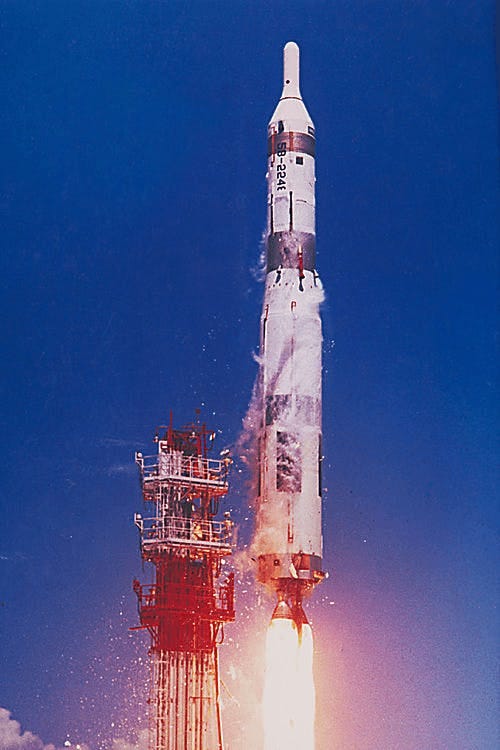
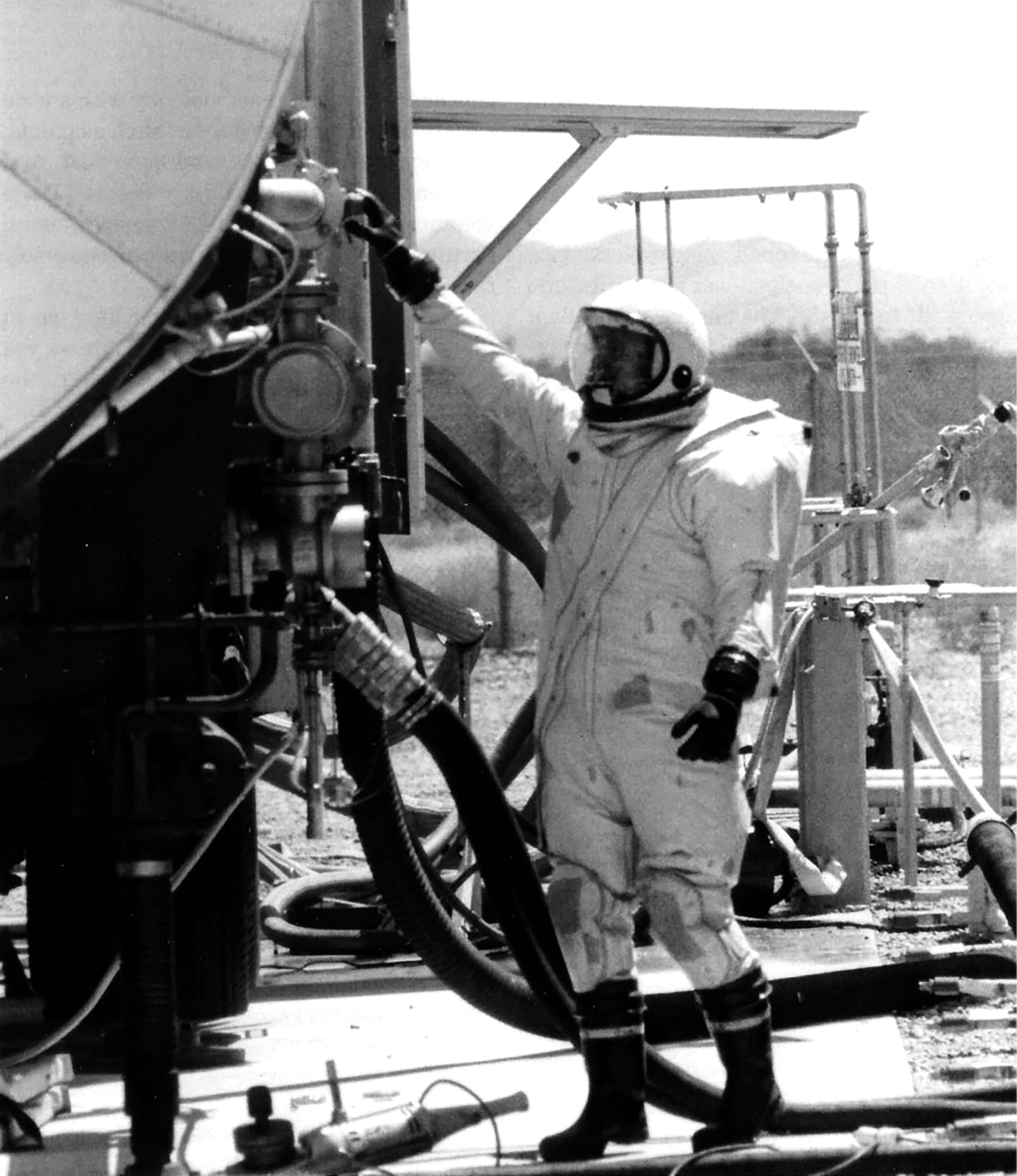
Titan II, the ICBM that followed Titan I, fixed the readiness problem by switching to hypergolic storable propellants, which could be loaded and left in the missile for years before igniting on contact, eliminating the ignition system. However, these propellants were toxic and corrosive, some destroying lung tissue even at low ppm, and others were both carcinogenic and flammable in air. Liquid-missile crews in the early 1960s worked in RFHCO (”rocket fuel handler’s clothing outfit”) suits while setting up these systems. Liquid-missile accident reports were almost exclusively associated with propellants, and included vapor clouds, Boiling Liquid Expanding Vapor Explosion (BLEVE), ruptures, and asphyxiations.
In October 1960, a Soviet liquid-missile ICBM ignited on the launch pad, killing an estimated 78 people. In Damascus, Arkansas, in 1980, a dropped socket wrench bounced against the ground and punctured a Titan II’s fuel tank, ejecting a 9-megaton warhead into a field several hours after it was struck by the wrench due to the buildup of propellant vapors. The dangers associated with liquid missile fuels during this period ultimately motivated the US and most other global defense agencies to move towards solids. US defense leaders elected to transition to entirely solid-propellant munitions, citing storability, safety, and operational simplicity as driving factors, in the 1980s, and retired the final liquid-fueled missile, the LGM-25C Titan II, in May 1987.
Solid Propulsion Systems
Missiles with solid propulsion systems, like the Boeing Minuteman (the successor to the Atlas and Titan ICBMs), could in a silo fully fueled for their entire service lives, prepared for launch with minimal preparation and requiring no maintenance. The propellant grain was cast into the motor casing once, at the factory, and the motor was effectively a sealed appliance, requiring no plumbing, pumping, cryogenic fuels, or toxic vapors. The launch crew’s job was monitoring and authentication, not propellant handling. The launch sequence for a solid rocket missile lasted about 60 seconds:
Two officers authenticate the order and turn keys simultaneously
Silo closure door is blown off by explosive bolts
Igniter fires the first stage
Missile flies
This quick turnaround from launch instructions (no fueling delay, no raising the missile, no countdown hold for valve opening) made true launch-on-warning and ride-out-and-respond doctrines possible.
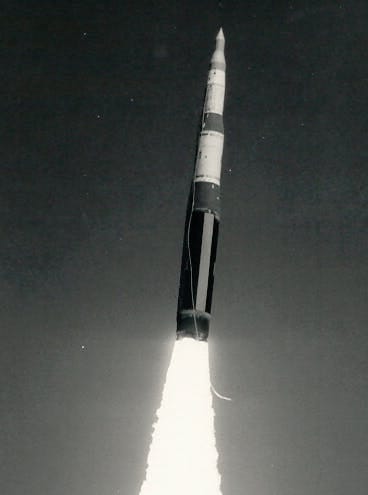
Unlike liquid engines, SRMs cannot be easily throttled, shut off, or restarted once lit. The propellant chemistry, grain shape (star, finocyl, slotted), nozzle throat erosion, and case insulation must all be modeled and qualified precisely before flight because the missile burns to completion on whatever thrust profile is baked into the geometry of the grain.
Progress in solid propulsion systems enabled the launch of the Polaris A-1 from the USS George Washington submarine in late 1960. The missile was gas-ejected from its tube by a steam generator, breached the surface, and ignited in the air. Cryogenic liquid fuel missiles couldn’t be prepared inside a submerged submarine because of the risks of explosion. Solid propellant made the submersible leg of the US nuclear triad, encompassing land, sea, and air launch, physically possible.
In contrast to liquid-missile preparation crews, solid-missile crews sat in hardened launch control capsules underground waiting for launch direction. The propellant was somebody else’s problem, finished years earlier.
Supply Chain
Despite the simplicity of operating solid-propellant missiles, the production of SRMs remained challenging, ultimately shrinking the defense contractors building these parts from six in 1995 to only two in 2017 before rising back to four as of May 2026.
Ammonium Perchlorate Production
While the contraction in SRM builders is a real bottleneck for continued missile production, the drivers of this contraction make it unlikely that further investment will be sufficient to solve this problem without fundamental innovations. Specifically, the supply of AP required to build solid rocket motors contracted during the same post-Cold-War period that demand for new missiles fell, eliminating commercial incentives for new chemical producers. The construction of the one remaining domestic AP production plant, the American Pacific Corporation (AMPAC) in Cedar City, Utah, took place in 1989, just 18 months after the PEPCON disaster. Demand was actually guaranteed jointly by NASA and the DoD in 1989 in order to ensure that AP production in the US continued. The organizations funded the construction of a second AP production site and enabled producers to add a surcharge to the per-pound price of AP, which flowed through subcontractors and prime contractors back to the government as reimbursable costs. The government guaranteed minimum annual purchases for seven years, supplying both NASA and DoD missions that would have been critically vulnerable without the added production.
Composite solid propellants are typically formulated as 68-73% ammonium perchlorate (AP, NH₄ClO₄) oxidizer and 15-20% spherical aluminum powder fuel suspended in a hydroxyl-terminated polybutadiene (HTPB) prepolymer matrix, cured with an isocyanate into a crosslinked elastomer. Batches are mixed under vacuum in vertical planetary mixers, cast into insulated motor cases around a mandrel that defines the grain geometry. Consistency and precision of grain geometry govern the ballistic predictability of missiles: the burn rate is a function of local pressure and exposed surface area, so any unintended discontinuity (like porosity, propellant cracks, or case-liner-propellant debonds) instantaneously increases burn surface and drives chamber pressure up, producing either a catastrophic burst or a transition from deflagration to detonation.
The above is an excerpt from our new deep dive on rethinking the missile supply chain. See the full report here.